Study facts at a glance
Participants: Ninety people enrolled; 15 withdrew before randomization, and 75 completed the three-treatment study. Source 1
Time on treatment: Each treatment period lasted 22 weeks: three periods totaling approximately 66 weeks, not 22 weeks overall. Source 1
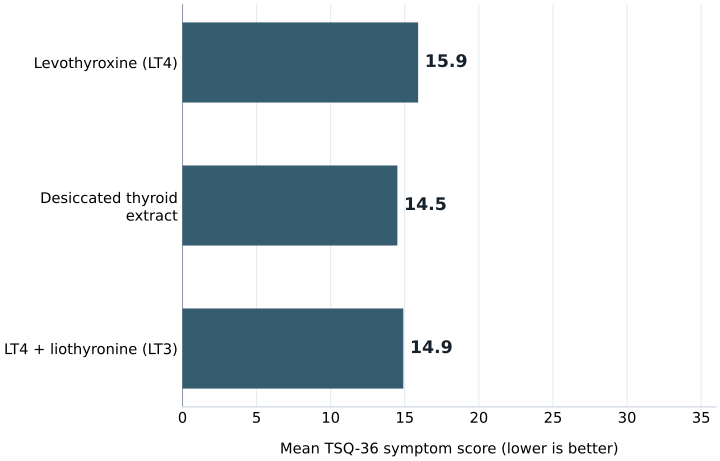
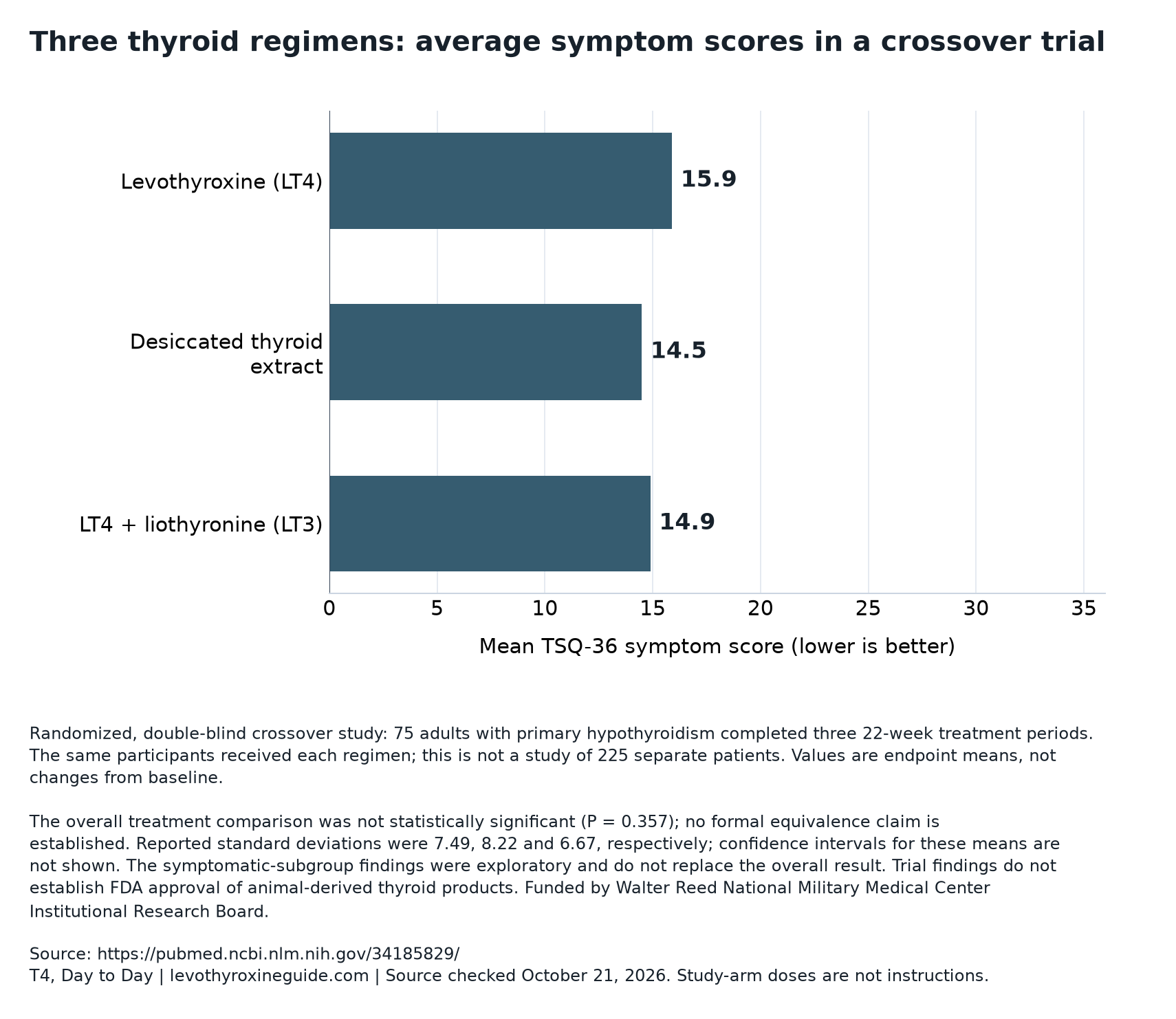
Main symptom result: Mean TSQ-36 scores were 15.9 with levothyroxine, 14.5 with desiccated thyroid extract, and 14.9 with combination treatment; the overall comparison was not significant. Source 1
Exploratory signal: The highest thyroid-symptom score group contained 20 participants. Its findings were outside the trial's primary outcomes and need prospective confirmation. Source 1
Safety and approval are separate: No adverse effects were reported, but heart rate was modestly higher with desiccated thyroid extract. FDA states that animal-derived thyroid medications are not FDA approved. Source 1 Source 4
The trial compared replacement options, not treatment with no treatment
The three arms were oral levothyroxine, abbreviated LT4; desiccated thyroid extract, or DTE; and levothyroxine plus oral liothyronine, abbreviated LT3. Levothyroxine supplies T4, while liothyronine supplies T3. DTE contains both hormones. Participants received each option in turn, allowing investigators to compare a person's outcomes across treatments rather than relying only on comparisons between different people.
This was an active-treatment comparison in adults with established primary hypothyroidism, meaning the underlying problem originated in the thyroid gland. It did not test whether thyroid replacement was necessary. Nor did it compare treatment with placebo. That distinction is essential when interpreting persistent symptoms: failure to find one replacement option superior does not establish that replacement itself has no benefit.
The study was funded by Walter Reed National Military Medical Center's Institutional Research Board. One author disclosed consulting relationships with Synthonics, BLA Technology, and Allergan; the other authors declared no competing financial interests. Research funding and disclosures help describe the evidence, but the design and results remain the basis for interpretation.
Read the underlying chart data: download CSV or download the source-labeled chart.
Who completed the three treatment periods
The 75 completers averaged 50 years old, with an actual age range of 29–65. Women accounted for 77.3%, and 77.3% were White. Participants were beneficiaries of the military health care system. Causes of hypothyroidism included autoimmune disease in 46 people, thyroidectomy in 16, previous radioiodine treatment in four, and an unexplained cause in nine.
Eligibility emphasized stable replacement treatment, but the baseline medication table included 64 people taking LT4, eight taking DTE, and three taking LT4 plus LT3. Thus, the study should not be described as having every participant on levothyroxine alone before enrollment. Fifteen of the original 90 enrollees withdrew because of relocation or scheduling conflicts before randomization—not because a randomized treatment caused side effects.
The selection criteria also narrowed the safety question. Investigators excluded pregnancy, cardiac disease, substantial kidney or liver dysfunction, malabsorption disorders, and several medications that could complicate assessment. These exclusions helped create a more controlled comparison but left important everyday populations unrepresented, particularly older adults with cardiovascular disease and people managing multiple interacting treatments.
Why the crossover lasted about 66 weeks
Participants were randomized to treatment sequences and crossed over until they had received all three medications. Each period lasted 22 weeks. At six weeks, thyroid-stimulating hormone, or TSH, was checked and treatment adjusted to the study's reference range of 0.27–4.20. Participants then continued for another 16 weeks before end-of-period assessment. Three such periods add up to approximately 66 weeks.
The research pharmacy placed the study products in identical capsules. Participants, evaluating physicians, cognitive-test administrators, and test analysts were blinded. A separate physician handled dose adjustments without other participant contact. These arrangements reduced the chance that knowing a treatment's identity would influence symptom reporting, testing, or assessment.
All study medication was taken orally once daily under a standardized morning routine. Adherence was evaluated through interviews, capsule counts, refill monitoring, and thyroid tests. These are study procedures, not a personal regimen or conversion guide. The controlled routine also matters when comparing this experiment with ordinary care, where food, supplements, and medication timing may vary; the food and supplement questions guide addresses that discussion.
The primary outcomes showed no overall winner
The investigators assessed thyroid symptoms with their TSQ-36 questionnaire, general well-being with GHQ-12, depressive symptoms with the Beck Depression Inventory, and memory with five Wechsler Memory Scale domains. The TSQ was a study-developed instrument modeled on earlier hypothyroidism questionnaires. Its results are useful within this experiment, but its measurement properties should not be assumed identical to those of other thyroid symptom scales.
For TSQ-36, the DTE mean was 1.4 points lower than the LT4 mean, while the combination mean was 1.0 point lower. Those are descriptive differences on a symptom scale, not percentages of patients helped. The overall treatment comparison had P=0.357. GHQ-12, depression scores, and all five memory domains likewise showed no statistically significant overall treatment differences.
The values in parentheses in the table are standard deviations, which describe how much participant scores varied. They are not confidence intervals for treatment effects. The report did not establish formal equivalence or noninferiority using a predefined acceptable-difference margin. Its conclusion is therefore narrower: this trial did not detect an overall advantage, rather than proving that all three treatments produce identical effects.
Selected whole-group outcomes; values are mean (standard deviation), not confidence intervals.
| Measure | LT4 / DTE / LT4 + LT3 | Overall comparison |
|---|---|---|
| TSQ-36 thyroid symptoms | 15.9 (7.49) / 14.5 (8.22) / 14.9 (6.67) | P=0.357 |
| GHQ-12 general well-being | 11.9 (5.13) / 11.7 (6.16) / 11.6 (4.83) | P=0.891 |
| Beck Depression Inventory | 7.15 (7.11) / 7.09 (8.55) / 7.33 (7.67) | P=0.947 |
| Visual memory index | 80.4 (12.1) / 79.8 (8.06) / 81.0 (11.3) | P=0.518 |
Hormone levels changed more clearly than symptoms
Morning blood samples were collected fasting and before the day's dose. Mean total T3 was 103 ng/dL with LT4, 155 with DTE, and 132 with combination treatment. Mean total T4 moved in the opposite direction: 8.46, 5.62, and 6.92 micrograms/dL, respectively. Mean TSH values remained within the reference range, although DTE produced a somewhat higher mean TSH.
These findings demonstrate that the treatment arms produced different circulating hormone profiles. They do not show that a higher T3 result necessarily improved how someone felt. Investigators could not establish a correlation between serum T3 and outcomes, including in subgroup analyses. Moreover, a predose blood sample does not represent the full day's exposure, particularly for the shorter-lived T3 hormone.
Weight, cholesterol measures, and other assessed metabolic markers did not differ significantly across treatments. The authors proposed that tissue-level or brain thyroid signaling might help explain residual symptoms, but the trial did not measure a causal brain mechanism. A related practical issue is test validity: the official label describes biotin interference, discussed in the thyroid blood-test guide. Neither a surprising laboratory value nor a symptom change explains itself.
The symptom subgroup was interesting—and smaller than it sounds
To explore whether average results concealed different responses, investigators ranked participants by their scores during the LT4 period and created low, middle, and high groups. These were exploratory analyses, not the primary outcomes on which the trial's main sample-size calculation rested. For TSQ-36, score cutoffs produced groups of 30, 25, and 20 people—not three equal groups of 25.
People with the highest TSQ symptom scores showed greater improvement with both combination treatment and DTE relative to the lower-score groups. The report also described favorable patterns for depressive symptoms and for participants with the poorest visual memory performance. However, the results were not uniform across every measure: GHQ-12 changes with DTE were numerically favorable in the middle and high groups but were not statistically significant.
Different measures defined their own groups, so the most symptomatic TSQ group should not automatically be treated as the same set of people as the worst memory group. The investigators also found no clear outcome differences by autoimmune versus nonautoimmune cause or the studied DIO2 genetic variant. The number with the homozygous variant was too small for a meaningful exclusion of a genetic effect.
Why a promising subgroup needs another trial
Selecting people because they scored poorly under one treatment creates a statistical challenge. An unusually bad score can partly reflect temporary fluctuation or measurement noise. On another assessment, that person may score closer to their usual level even without a superior treatment. This is regression to the mean, a possibility the authors explicitly acknowledged.
The analysis also examined many outcomes and subgroups. Some pairwise comparisons used adjustments for multiple testing, but there was no overarching correction covering the large collection of secondary and subgroup analyses. Correlated symptom questionnaires can provide a coherent picture, yet they are not fully independent replications. Several favorable questionnaire findings therefore do not carry the same weight as several separately designed confirmatory trials.
The original power calculation targeted an eight-point within-person TSQ difference and required 67 participants under its assumptions. It did not establish adequate power for small between-subgroup comparisons. Interpretation: the useful next experiment would identify persistently symptomatic participants in advance, specify a primary endpoint and clinically meaningful difference, and test that question directly. This study supplies a rationale for that work, not a validated responder-selection tool.
Preference and tolerability added information, not a verdict
At the end, participants ranked the treatment periods without being told which medication each represented. DTE received more first-place rankings numerically, but overall preference did not differ significantly. The table also included ties and people with no preference, making a simple winner-versus-loser reading misleading. Preference is a meaningful patient-reported outcome, but it is not interchangeable with a demonstrated primary symptom benefit.
No adverse effects were reported, and no participant withdrew because of side effects. Nevertheless, mean heart rate was 71.5 beats per minute with LT4, 73.7 with DTE, and 70.4 with combination treatment; the overall comparison had P=0.04. DTE's mean was therefore 2.2 beats per minute above LT4's. Blood pressure did not differ significantly.
A small selected trial with 22 weeks on each treatment cannot resolve uncommon or long-term cardiovascular and skeletal risks. Official Synthroid labeling separately warns about cardiac effects and loss of bone mineral density with over-replacement. Those warnings do not prove that the study regimens caused those outcomes, but they explain why the absence of reported adverse events is not a blanket safety finding.
TRUST studied a different thyroid question
The TRUST analysis of symptoms after age 65 concerns 737 adults with persistent subclinical hypothyroidism: elevated TSH but free T4 within the reference range. Their mean age was 74.4. In that parallel-group trial, 368 received oral levothyroxine and 369 placebo, with primary symptom outcomes assessed at one year. Unlike the crossover study, each participant did not receive every treatment.
TRUST lowered mean TSH more with levothyroxine, but the reported between-group symptom difference was 0.0 points, with a 95% confidence interval of −2.0 to 2.1. The tiredness difference was 0.4 points, with a 95% confidence interval of −2.1 to 2.9. Both scales ran from 0 to 100; their stated minimum clinically important difference was nine points. The intervals therefore did not support an average benefit approaching that threshold.
The indexed abstract reports no significant excess of prespecified serious adverse events and funding from European Union FP7 and others. This discussion uses that primary-report abstract, not a review of all TRUST protocols or supplements. Its findings should not be used to infer that people with established replacement-dependent hypothyroidism can withdraw therapy: that was not the population or intervention studied.
Two trials addressing different decisions, not interchangeable estimates of thyroid treatment benefit.
| Design feature | Three-treatment crossover | TRUST |
|---|---|---|
| Population | 75 completers with established primary hypothyroidism; ages 29–65 | 737 adults at least 65 with persistent subclinical hypothyroidism |
| Comparison | LT4, DTE, and LT4 + LT3 in the same people | Levothyroxine versus placebo in separate groups |
| Timing | 22 weeks per treatment; approximately 66 weeks overall | Primary symptom assessment at one year |
| Main symptom finding | No significant overall treatment differences | No average symptom or tiredness benefit despite lower TSH |
What belongs in a clinical review
Regulatory status must come from current official information, not a historical trial's background section. FDA states that animal-derived thyroid medications, including DTE, are not FDA approved. Its page describes planned guidance and a risk-based enforcement approach, including quality concerns involving hormone levels, potency, purity, and impurities. It does not establish a blanket withdrawal deadline. Participation in a published trial is not FDA approval.
Interpretation for daily care: the useful questions are what symptoms persist, how consistently they have been measured, what the laboratory results actually show, and what medication or testing factors could complicate interpretation. The care-record comparison guide and manufacturer-change guide can help organize those questions without assuming that a formulation change explains every symptom.
Interpretation for service selection is narrower still: research outcomes do not establish a provider's capabilities, contractual obligations, or results. The Paloma Health review and Sesame review are places to check documentary terms about records, visits, and continuing responsibilities—not evidence that either offers the studied products or reproduces trial outcomes. The results also do not transfer automatically to compounded products, different formulations, or different schedules.
Questions about the evidence
Does a normal TSH mean persistent symptoms are unimportant?
No. The study measured symptoms and cognition separately from TSH, recognizing that a laboratory target and daily well-being are different outcomes. But persistent symptoms alone did not identify a proven need for T3 treatment. The unresolved question is which symptoms, measured consistently and considered alongside other clinical factors, predict a reproducible treatment benefit.
Did the trial prove that DTE and levothyroxine are equivalent?
No. It found no statistically significant overall differences in the primary outcomes. Formal equivalence would require a prespecified margin defining how different treatments could be while still counting as equivalent, along with appropriate effect estimates and uncertainty. A nonsignificant comparison is not that proof.
Could the subgroup findings still reflect a real benefit?
Yes. Exploratory findings can identify genuine treatment differences that deserve confirmation. Here, the symptom and preference patterns support further investigation. However, small groups, selection based on LT4-period scores, regression to the mean, and numerous analyses prevent confidently identifying an individual responder from these results.
Did higher blood T3 explain improved memory or mood?
The trial did not establish that explanation. T3-containing treatments raised predose serum T3, but investigators could not demonstrate a correlation between serum T3 and outcomes. Their proposed tissue and brain mechanisms remain hypotheses. Blood measurements, local hormone processing, and a person's cognitive performance are related scientific questions, not interchangeable measurements.
Was weight loss a reason to favor one treatment?
Not in this trial: weight did not differ significantly among the three arms. The paper discussed an earlier two-treatment study with a weight finding, but that was a separate experiment. Official Synthroid labeling also states that thyroid hormone should not be used to treat obesity or for weight loss.
What this evidence supports
The strongest result is the whole-group comparison: three replacement approaches produced different hormone profiles without a detected average advantage in symptoms, mood, quality of life, or memory. The most scientifically productive uncertainty is whether a prospectively defined group with persistent symptoms benefits from T3-containing treatment. This trial raises that possibility but does not settle it. Its modest heart-rate finding, selected population, and limited exposure to each treatment also leave long-term safety unanswered. For clinical review, laboratory response, meaningful symptom response, treatment preference, and safety belong together—but none substitutes for the others.
Research access and limitations
The crossover analysis uses the open-access primary article and indexed abstract. TRUST is assessed from its indexed primary-report abstract, not all protocols, supplements, or full-text analyses. Regulatory context comes from the official FDA material, and levothyroxine safety context comes from official DailyMed prescribing information. The article does not provide individual dosing, conversion, or medication-change instructions.