Study facts at a glance
Who was studied: TRUST randomized 737 adults aged at least 65; mean age was 74.4 years. Participants had persistent elevated TSH with normal free thyroxine. Source 1
Laboratory response: Mean TSH at one year was 3.63 mIU/L with levothyroxine versus 5.48 mIU/L with placebo, from an overall baseline mean of 6.40 mIU/L. Source 1
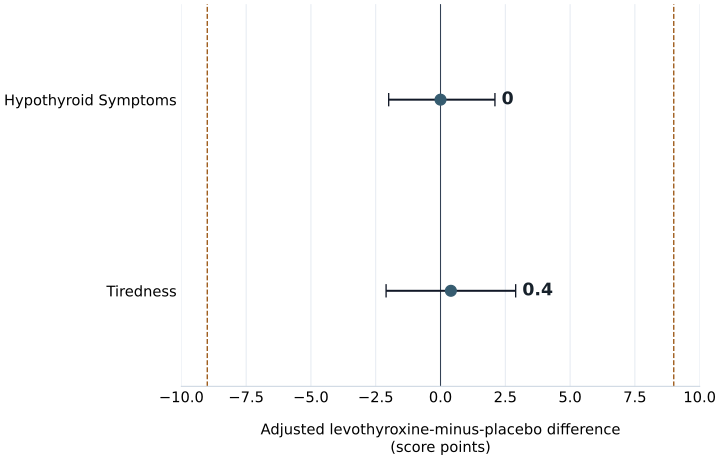
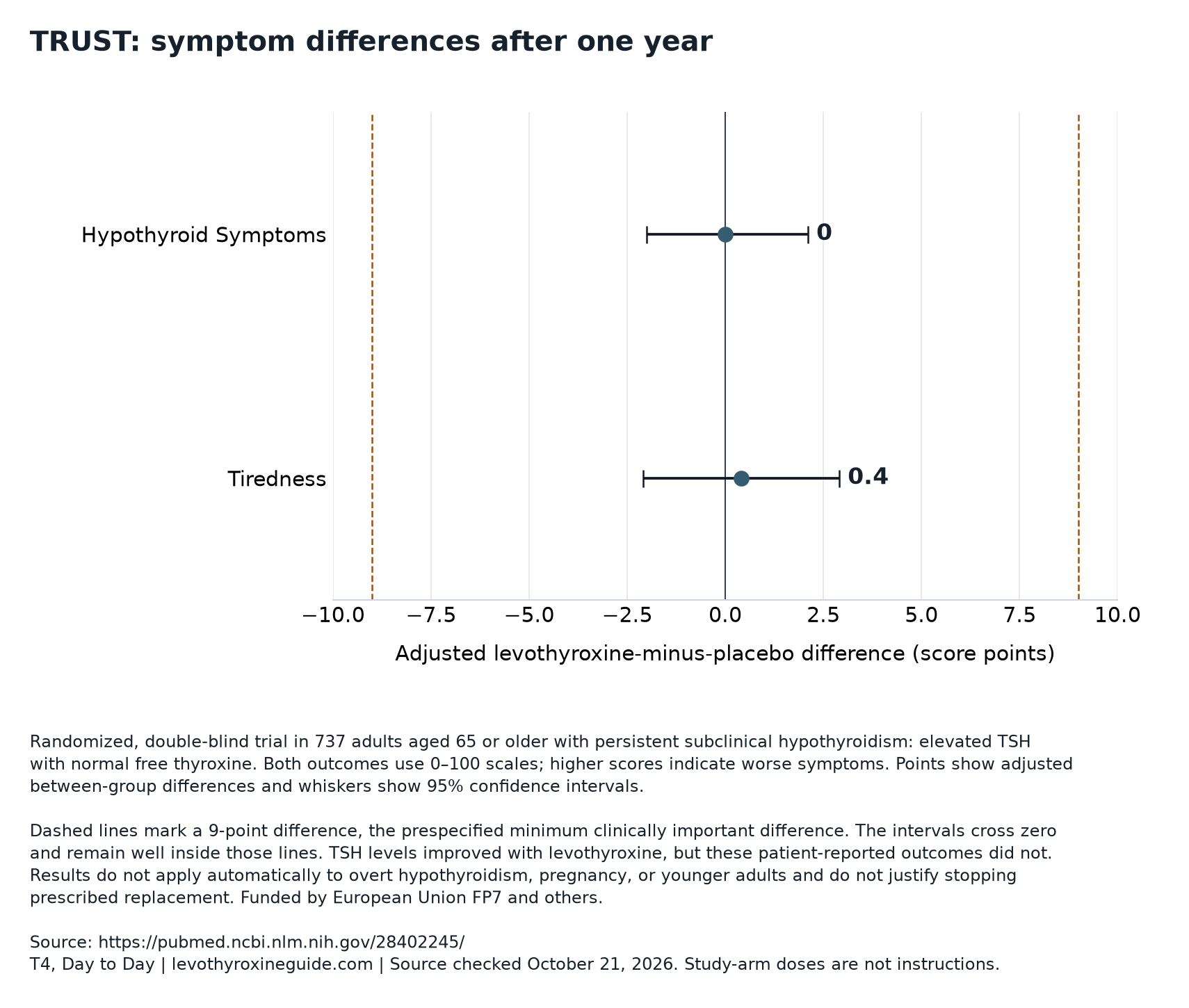
Primary symptom results: The reported between-group differences were 0.0 points for hypothyroid symptoms (95% CI, −2.0 to 2.1) and 0.4 points for tiredness (95% CI, −2.1 to 2.9). Source 1
Meaningful-change benchmark: Both primary scales ranged from 0 to 100, with higher scores worse; the trial identified 9 points as the minimum clinically important difference. Source 1
Related evidence is partly overlapping: The high-symptom analysis reused TRUST data, and the age-80-plus analysis combined another trial with older TRUST participants. Neither is a wholly independent replication of TRUST. Source 3 Source 4
The specific thyroid pattern TRUST tested
Subclinical hypothyroidism is a laboratory pattern: TSH is elevated while free thyroxine, often called free T4, remains within the reference range. TSH is the pituitary signal that stimulates thyroid hormone production. Its elevation does not, by itself, establish that fatigue or another symptom will improve when additional hormone is given. TRUST tested that treatment question rather than assuming the laboratory pattern explained how participants felt.
Eligibility required persistent subclinical hypothyroidism, a TSH of 4.60 to 19.99 mIU/L, and normal free T4. The participants' average starting TSH was 6.40 mIU/L, with a standard deviation of 2.01. Thus, although the eligibility range extended considerably higher, the average participant had a relatively mild elevation. An eligibility ceiling is not evidence that the trial answered every question equally well throughout that range.
The mean age was 74.4 years, and 396 participants, or 53.7%, were women. These characteristics anchor the interpretation to older adults. They do not make TRUST a study of pregnancy, younger adults, thyroid removal, or every reason for thyroid replacement. Keeping the original diagnosis alongside subsequent results is also the organizing principle behind the care-records comparison guide.
Read the underlying chart data: download CSV or download the source-labeled chart.
How randomization separated treatment from expectation
TRUST was a double-blind, randomized, placebo-controlled, parallel-group trial. Researchers assigned 368 participants to levothyroxine and 369 to placebo. Parallel-group means that the two groups followed separate assigned treatments, rather than each participant cycling through both. Randomization made the placebo group a more credible estimate of what would have happened without active treatment than a simple before-and-after comparison.
The oral levothyroxine regimen began at 50 micrograms daily, or 25 micrograms for participants weighing less than 50 kilograms or with coronary heart disease. Researchers adjusted treatment using TSH; the placebo group underwent mock adjustment to preserve blinding. These numbers describe the study arms, not a dosing plan for readers. The median active-treatment dose at one year was 50 micrograms.
Blinding was especially relevant because the main outcomes were participants' reports of symptoms. Expectations and the experience of receiving care can influence such reports in either group. A matching placebo and simulated adjustment helped make those experiences comparable. The study was funded by European Union FP7 and others; its registered trial identifier was NCT01660126.
A clear laboratory effect, measured against the right comparator
At one year, mean TSH was 3.63 mIU/L in the levothyroxine group and 5.48 mIU/L in the placebo group. The 1.85 mIU/L separation supports a real biochemical effect of the intervention. This is important: an absent symptom benefit cannot simply be explained by saying that the assigned treatment did not alter the measured thyroid signal.
The placebo group's TSH also fell from the overall starting mean. That observation illustrates why treatment effects should not be attributed solely from changes over time. Biological variation and other influences can change a laboratory value even without active therapy. The randomized comparison, rather than the active group's starting-to-ending change alone, isolates the evidence for the drug's effect.
Laboratory interpretation also depends on how a test was obtained. Official labeling identifies biotin-related assay interference and food or drug effects on levothyroxine absorption. Those issues were not demonstrated explanations for TRUST's symptom results. They are separate questions for real-world review, explored in the guides to biotin and thyroid blood tests and food and supplement questions.
What the symptom estimates actually mean
The two primary outcomes were one-year changes in the Hypothyroid Symptoms and Tiredness scores on a thyroid-related quality-of-life questionnaire. Each scale ran from 0 to 100, with higher scores indicating worse symptoms. These were score differences—not percentages, percentage-point changes, or risks of an event. The trial's 9-point minimum clinically important difference supplied a benchmark for a change large enough to matter clinically.
For hypothyroid symptoms, mean change was 0.2 points in each group. The reported between-group difference was 0.0, with a 95% confidence interval from −2.0 to 2.1. For tiredness, displayed mean changes were 3.2 with placebo and 3.8 with levothyroxine; the report's between-group estimate was 0.4, with a confidence interval from −2.1 to 2.9. The reported estimate should be retained rather than replaced by subtraction of rounded arm means.
Both intervals lie well inside the 9-point benchmark in either direction. The result is therefore more informative than merely failing to cross a statistical-significance threshold: it argues against a large average symptom benefit at one year under these trial conditions. It does not establish that every participant had an identical response. The abstract also reports no beneficial effects on secondary outcomes, without enough detail to independently assess each secondary measure.
TRUST at one year: biochemical change and patient-reported outcomes
| Measure | Reported result | Interpretation |
|---|---|---|
| Mean TSH | 3.63 mIU/L with levothyroxine; 5.48 with placebo | A biochemical separation of 1.85 mIU/L |
| Hypothyroid Symptoms score | Between-group difference 0.0; 95% CI, −2.0 to 2.1 | No average symptom advantage; interval excludes a 9-point benefit |
| Tiredness score | Between-group difference 0.4; 95% CI, −2.1 to 2.9 | No average tiredness advantage; interval excludes a 9-point benefit |
| Score direction | 0–100; higher is worse | Score points are not percentages or event risks |
Did greater starting symptoms reveal a benefit?
A reasonable concern was that an overall average might conceal benefit among people who were more symptomatic initially. A post hoc secondary TRUST analysis addressed that possibility using 638 participants with complete outcome data. High symptom burden meant a baseline Hypothyroid Symptoms score above 30 or Tiredness score above 40. There were 132 participants above the symptom threshold and 133 above the tiredness threshold; these counts should not be added as if they necessarily represented different people.
Among those with high hypothyroid symptom scores, symptoms improved by 12.3 points with levothyroxine and 10.4 points with placebo. The adjusted between-group difference was −2.0 points, with a 95% confidence interval from −5.5 to 1.5. For high tiredness, improvements were 8.9 and 10.9 points, respectively; the adjusted difference was 0.0, with an interval from −4.1 to 4.0.
This is a useful worked example of why improvement during treatment is not the same as improvement caused by treatment. Both groups felt better on average. The analysis found no evidence that baseline symptom burden modified treatment effects, but its post hoc design, small high-symptom groups, and restriction to complete cases limit certainty. It also reexamined TRUST participants rather than supplying a new randomized replication.
What the prospectively planned age-80-plus analysis added
A separate, prospectively planned combined analysis focused on community-dwelling adults aged 80 or older. It included 251 participants: 105 from one trial and 146 from TRUST. Their mean age was 85 years; 112 received levothyroxine and 139 placebo. A total of 212, or 84%, completed the study. Unlike the high-symptom analysis, this combined analysis was planned in advance.
At one year, the adjusted difference in hypothyroid symptoms was 1.3 points, with a 95% confidence interval from −2.7 to 5.2. The adjusted tiredness difference was −0.1 points, with an interval from −4.5 to 4.3. Neither showed a statistically significant benefit, and both intervals remained within the same 9-point clinically important difference benchmark.
This analysis extends the age-specific evidence but does not create a wholly independent third test of the original finding. Some participants were already in TRUST. The completion rate also matters: an analysis with incomplete follow-up warrants attention to missing outcomes, though the abstract does not permit a detailed reconstruction of that handling. Its conclusion concerns routine treatment of subclinical disease in this age group, not replacement for overt hormone deficiency.
Related reports answer different questions and share some participants
| Report | Design and population | What it adds |
|---|---|---|
| Main TRUST trial | 737 randomized adults aged at least 65 | Primary placebo-controlled comparison at one year |
| High-symptom analysis | Post hoc analysis of 638 TRUST complete cases | Tests whether greater baseline symptoms identified benefit |
| Age-80-plus analysis | Prospectively planned pooling; 251 people from two trials | Focuses on the oldest adults; includes 146 TRUST participants |
The safety findings were narrower than a no-risk claim
TRUST reported no significant excess of serious adverse events prespecified as being of special interest. That is a real safety finding, but its wording has boundaries. It concerns a selected event category during the study, and the abstract does not provide the counts needed to estimate individual event differences. A nonsignificant comparison cannot prove that uncommon or longer-term harms do not occur.
In the age-80-plus analysis, at least one adverse event occurred in 33 of 112 levothyroxine recipients, or 29.5%, and 40 of 139 placebo recipients, or 28.8%. These are all-cause adverse-event proportions, not necessarily events caused by treatment. Their numerical closeness does not establish safety equivalence, especially in a relatively small sample.
Official Synthroid labeling supplies a different kind of evidence: established prescribing warnings. It identifies cardiac concerns, including atrial fibrillation with overtreatment in older adults, and reduced bone mineral density with over-replacement. Its boxed warning states that thyroid hormones are not treatments for obesity or weight loss. These warnings remain relevant even when a particular symptom trial does not detect a significant serious-event excess.
Why the three-treatment crossover trial is a different question
A separate randomized, double-blind crossover study compared oral levothyroxine, levothyroxine plus liothyronine, and desiccated thyroid extract in 75 people with established primary hypothyroidism. Actual ages ranged from 29 to 65, with a mean of 50. Each participant received each treatment for 22 weeks—about 66 weeks across three periods. This was not a placebo-controlled test of adding hormone for mild subclinical disease.
Overall primary symptom, general-health, depression, and memory outcomes did not differ significantly among treatments. The study reported no adverse effects or withdrawals because of side effects, but heart rate averaged 73.7 beats per minute on desiccated thyroid extract, versus 71.5 on levothyroxine and 70.4 on combination treatment. Its size and selected population do not establish broad long-term cardiac safety.
Secondary analyses found favorable signals for T3-containing treatments among some of the most symptomatic participants, but these were not the primary powered comparisons. Multiple testing, small subgroups, and regression toward the mean complicate interpretation. The three-treatment crossover analysis explains those distinctions in depth. Neither study proves that all thyroid replacement fails, nor does either establish a general solution for persistent symptoms.
Questions the evidence still leaves open
TRUST's strongest answer concerns average one-year symptom effects in the older population it enrolled. It is less decisive about people near the high end of the eligible TSH range because the average starting value was much lower. Without reported estimates for a specifically defined higher-TSH subgroup, it would be inappropriate to invent a subgroup benefit or declare that subgroup conclusively settled.
The accessible abstracts also do not supply a complete basis for judging uncommon long-term outcomes, detailed adherence patterns, or every reason someone might have fatigue. A thyroid-related questionnaire measures an important patient experience, but it cannot by itself identify the cause of that experience. The absence of average treatment benefit does not mean the symptoms were unreal or that their explanation was discovered.
Another unresolved issue is prediction: could a prospectively defined set of characteristics identify a reproducible responder group? The high-symptom analysis did not establish one in TRUST. The younger crossover trial's exploratory signals arose in a different clinical setting and cannot fill that gap. A persuasive answer would require the right population, a planned comparison, and sufficient precision—not retrospective selection of people who happened to improve.
Bringing the laboratory–symptom distinction into a care review
Editorial interpretation: the practical value of TRUST is a better review question, not an automatic medication decision. Does the person's original diagnosis resemble persistent subclinical hypothyroidism in this trial, or a different condition requiring replacement? Which outcome is being evaluated—TSH, tiredness, another symptom, or a separate clinical concern? Are laboratory results and symptom descriptions recorded over comparable periods?
A medication record can also support questions about formulation changes, interactions, and test interpretation without assuming any one explains persistent symptoms. The manufacturer-change guide offers a framework for clarifying the prescription history. Clinical findings from monitored trial regimens do not automatically establish outcomes for other formulations, compounded products, or a particular care service.
Editorial interpretation: service arrangements should be assessed separately from drug efficacy. Readers comparing administrative terms can consult the Sesame review or Paloma Health review to check documentary terms. Those links do not establish product availability, condition-specific care, or trial-like outcomes. TRUST measured clinical outcomes, not provider quality, contract value, or the best individual treatment plan.
Questions about the evidence
Does lowering TSH mean levothyroxine is helping someone feel better?
Not necessarily. TRUST demonstrated a laboratory response without a corresponding average improvement in its primary symptom scores. TSH and patient experience are distinct outcomes. That does not make the laboratory result unimportant; it means that symptom benefit needs its own evidence rather than being inferred from the blood test.
Could participants with worse fatigue have benefited more?
The post hoc high-symptom analysis tested that possibility and did not find an advantage over placebo. People with high tiredness improved in both groups, with an adjusted between-group difference of 0.0 points. The smaller sample and complete-case design leave uncertainty, but the analysis did not establish high baseline fatigue as a treatment-response marker.
Do these findings apply to everyone taking thyroid replacement?
No. TRUST enrolled older adults with elevated TSH and normal free T4. It did not test withdrawal of established replacement, nor did it answer treatment questions for pregnancy, thyroidectomy, or overt hypothyroidism. Official labeling describes replacement indications broader than the narrow clinical question studied in TRUST.
Are the high-symptom and age-80-plus reports independent confirmations?
Not fully. The high-symptom report reused TRUST data. The prospectively planned age-80-plus report combined a separate trial with 146 TRUST participants. They offer useful additional perspectives, but counting all three publications as independent populations would overstate the evidence.
Did TRUST show that levothyroxine has no serious risks?
No. It found no significant excess in prespecified serious events of special interest, which is narrower than proving no risk. Official labeling warns about overtreatment-related cardiac and bone effects and explicitly rules out use for obesity or weight loss. Individual benefit–risk review remains a different task from interpreting an average trial result.
What this evidence supports
TRUST provides persuasive evidence that lowering TSH with levothyroxine did not yield a clinically important average improvement in hypothyroid symptoms or tiredness at one year among the older adults with persistent subclinical hypothyroidism studied. Its confidence intervals make a large average benefit unlikely, while the related analyses do not identify a convincing exception based on greater symptoms or age over 80. The central lesson is specific: biochemical response and meaningful symptom response must be evaluated separately. It is not a conclusion about every thyroid disorder or a basis for an individual starting, stopping, or dosing decision.
Research access and limitations
The TRUST discussion uses indexed primary report abstracts for the main trial and related analyses, not a review of their full protocols or supplements. Full primary text was available for the separate crossover comparison, and official DailyMed prescribing information was available for safety and indication context. Abstract-level reporting limits detailed assessment of missing data, individual adverse events, adherence, and secondary endpoints.